BepiColombo Reaches Mercury After Eight Years and Nine Flybys
BepiColombo has entered orbit around Mercury after a journey that included nine planetary flybys and a change of course following a thruster problem. The European and Japanese mission’s two spacecraft are expected to separate around December 9, with scientific observations starting in April.
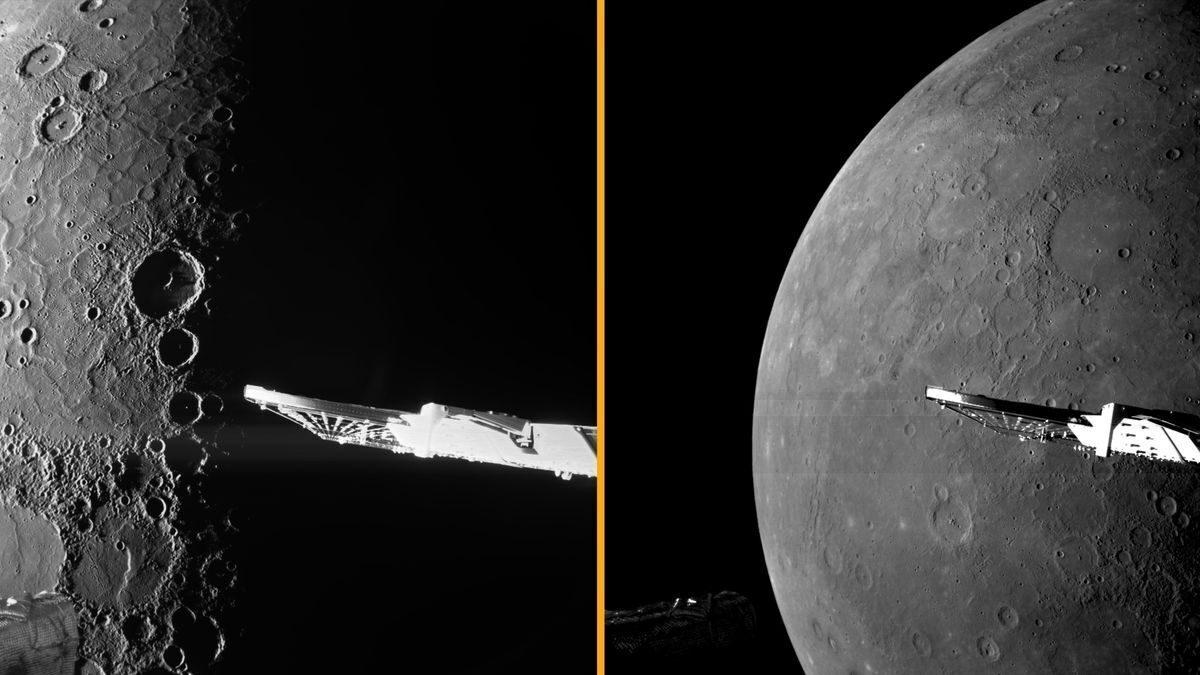
BepiColombo has entered orbit around Mercury after eight years in space and nine planetary flybys. The European and Japanese mission carries two spacecraft that will study the planet’s surface and its interaction with the Sun. They are expected to separate around December 9, before scientific observations begin in April.
BepiColombo is only the second mission to orbit Mercury, following NASA’s MESSENGER. It is a collaboration between the European Space Agency and the Japan Aerospace Exploration Agency.
Professor Geraint Jones, BepiColombo’s lead project scientist, said: “For the first time, we'll have a single mission with two orbiters going around the same planet.”
Nine flybys slowed the spacecraft
BepiColombo used nine planetary flybys to reach the correct orbit: one at Earth, two at Venus and six at Mercury. The maneuvers used the planets’ gravity to slow the spacecraft, helping it avoid flying past Mercury under the Sun’s pull.
Reaching the inner Solar System requires a spacecraft to lose orbital energy gained from launching from Earth. Flybys offer a more fuel-efficient alternative to relying on thrusters alone.
A thruster glitch in 2024 forced the flight team to change its plans. The problem prevented the thrusters from operating at full power, delaying the planned orbital entry by almost a year to November 21, 2026.
The team also directed the spacecraft closer to Mercury than its original safety plans allowed. On its fourth Mercury flyby, BepiColombo passed 165 kilometers (103 miles) above the surface, below the planned safe distance of 200 kilometers (120 miles).
Frank Budnik, who leads BepiColombo’s flight dynamics team, said of the thruster problem: “It was clear very quickly that with this reduced power availability, we will not be able to maintain the old mission.”
Two orbiters will study Mercury
The European agency’s Mercury Planetary Orbiter will map the surface and investigate how Mercury formed, why it is so dense and how it evolved over the last 4.5 billion years.
Japan’s Mercury Magnetospheric Orbiter, called Mio, will study the planet’s interaction with the Sun and space. Its targets include Mercury’s magnetosphere, the region influenced by its magnetic field, and its very tenuous atmosphere.
The mission will also test Einstein’s general relativity. Mercury is close enough to the Sun that classical mechanics cannot fully explain its orbit.
The Mercury Imaging X-Ray Spectrometer will analyze the chemical composition of the planet’s surface. Its team has already shared an X-ray image of the Crab Nebula, a supernova remnant.
During an earlier flyby, BepiColombo discovered aurora-like phenomena at Mercury. The mission is named after Italian mathematician and engineer Giuseppe “Bepi” Colombo, who showed how gravity assists could slow spacecraft traveling toward the inner Solar System.
 Take the quizWhat Kind of Holiday Spender Are You? Take the Black Friday QuizStart →
- 1Stock Market Today: Dow Slides 1.34% and VIX Jumps 15% at Midday

- 2Joachim Klement to Sell Stocks After S&P 500 Signal

- 3Stock Market Today: Nasdaq, S&P 500 Futures Slide as AI Selloff Deepens

- 4Kenneth Walker’s Groin Injury Puts Cardinals Game in Doubt

- 5Pat Cummins Faces Captaincy Doubts From Mitchell Johnson

 Lifestyle · Food & HealthNormal Blood Pressure Chart by Age: Healthy Ranges Explained
 Lifestyle · Food & HealthWhat Is Raynaud’s Syndrome? Why Fingers Turn White in the Cold
 Lifestyle · Food & Health4 Ways Walking After Meals Helps Your Body, Doctors Say
 Lifestyle · Food & Health4 Reasons to Eat Oatmeal, According to Nutrition Experts