COMECE Urges EU Court to Protect Baptismal Registers
COMECE has asked the European Union’s top court to protect baptismal registers from erasure. In a position paper, the Catholic body challenges an advocate general’s opinion and argues that the records document historical events rather than a person’s current religious membership.
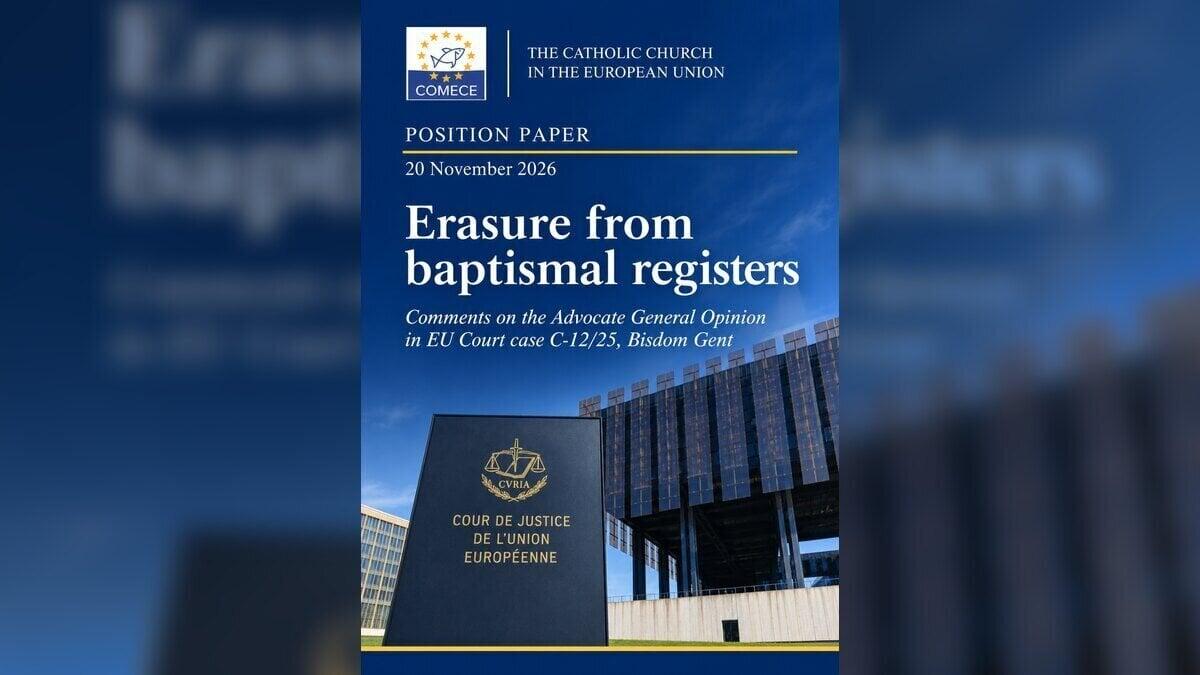
COMECE has urged the European Union’s top court to protect baptismal registers from erasure, arguing that the documents record historical events rather than current religious membership. Its position paper challenges an advocate general’s opinion in a case with implications for church-state relations.
The court has not issued its final ruling.
COMECE, a Catholic body in the European Union, prepared the position paper with support from its Legal Affairs Commission. It proposes a different interpretation of the case before the Court of Justice of the European Union.
Church body disputes erasure approach
COMECE says the advocate general’s opinion treats baptismal registers as relevant to defining membership of a religious community. The body argues that the records instead document a historical and sacramental fact.
It says the records serve several purposes in church life. These include establishing sacramental and canonical status, supporting later annotations and issuing reliable certificates throughout a person’s life.
COMECE also says the registers protect third parties’ rights and interests. It rejects the opinion’s proposed alternatives to storing baptismal data as insufficient.
Those alternatives include correspondence with the church about erasure. Another is a church-law provision allowing baptism to be established in certain conditions through a witness declaration or the baptized person’s oath.
COMECE argues that the church’s legitimate grounds for retaining the records should generally outweigh the individual’s interests, rights and freedoms. It also says a baptismal record does not necessarily reveal someone’s present beliefs or religious affiliation.
Annotations and archives at issue
The advocate general’s opinion rejects adding a note in the margin of a baptismal record to reflect the person’s wishes. COMECE defends that practice as a legal solution for situations where it says erasure is not possible.
The body argues that removing a person’s name, surname and date of birth would deprive the record of its essential content and purpose. It also objects to physical alterations such as opaque stickers, citing archival authenticity and integrity.
COMECE says baptismal registers have value for genealogical research and that the integrity of archives matters. It calls for a broader interpretation of public-interest archiving and historical research.
The body warns that the approach in the opinion could create legal uncertainty for church data controllers and increase litigation. It says parishes could face particular difficulties because of administrative limits.
COMECE has followed Case C-12/25, Bisdom Gent, since its inception. Its secretariat prepared a position paper after a hearing in September 2026 and issued a preliminary response to the advocate general’s opinion in October 2026.
 Take the quizWhat Kind of Holiday Spender Are You? Take the Black Friday QuizStart →





 Lifestyle · Food & HealthNormal Blood Pressure Chart by Age: Healthy Ranges Explained
 Lifestyle · Food & HealthWhat Is Raynaud’s Syndrome? Why Fingers Turn White in the Cold
 Lifestyle · Food & Health4 Ways Walking After Meals Helps Your Body, Doctors Say
 Lifestyle · Food & Health4 Reasons to Eat Oatmeal, According to Nutrition Experts