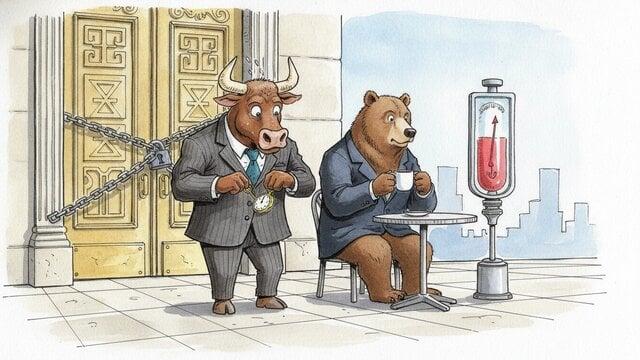
Citi Warns Stock-Market Risk Signal Is Close to Triggering
Citigroup strategists say a risk-management signal based on the largest S&P 500 stocks is likely to trigger. They point to weakness in major technology shares, a shift in market leadership and falling copper prices as reasons for concern.

Citigroup strategists say a key stock-market risk signal is close to triggering, as weakness in four major S&P 500 stocks raises concerns for investors. The signal tracks whether leading stocks have fallen below a long-term price measure.
The strategists, led by Dirk Willer, said the signal would trigger if four of the seven largest S&P 500 companies by market value stayed below their 200-day moving average for at least five days. They said a trigger was likely.
The four stocks are Meta Platforms, Broadcom, Alphabet and Nvidia. A 200-day moving average tracks a stock’s average closing price over that period.
Citi calls the measure its “Generals” concept. The strategists described it as a risk-management tool for reducing equity exposure when market leaders break down.
“The generals work by removing downside tails, not necessarily by having a very high standalone hit ratio,” the strategists wrote. They added that they saw enough warning signs to heed the signal.
Nvidia is a central concern for the team. Willer and his colleagues said 10% of the company’s revenue came from China and Hong Kong, and flagged a risk from export licenses under review following the Jensen Huang scandal.
The strategists also pointed to Nvidia’s financing exposure across the artificial intelligence ecosystem. They cited $118 billion in guarantee exposure, up $10 billion from the previous quarter.
They also cited $32 billion in financial backstops to neocloud operators, $20 billion in future equity commitments and $74 billion in data-center leases.
Citi identified parallels between the current shift among stock-market sectors and periods of market stress in 2000 and late 2021. In both periods, growth and momentum stocks lost favor relative to quality and value stocks, and the S&P 500 and Nasdaq suffered major drawdowns.
A shift from cyclical shares into defensive stocks was another warning sign, the strategists said. Cyclical stocks tend to be more sensitive to economic swings, while defensive stocks are generally considered less sensitive.
Weak copper prices also concerned the team. Analysts have long used copper as an indicator of overall economic growth, and Citi removed its buy recommendation on the metal at the end of October.
The London copper price has fallen from around $14,700 per metric ton to $12,500. Citi also noted that a strong dollar hurts copper prices.
If the AI bubble bursts, the strategists recommend bonds. They said a sell-off could damage the economy through the effect of falling wealth, as well as through the direct contribution from AI investment.
 Take the quizWhat Kind of Holiday Spender Are You? Take the Black Friday QuizStart →




 Lifestyle · Food & HealthNormal Blood Pressure Chart by Age: Healthy Ranges Explained
 Lifestyle · Food & HealthWhat Is Raynaud’s Syndrome? Why Fingers Turn White in the Cold
 Lifestyle · Food & Health4 Ways Walking After Meals Helps Your Body, Doctors Say
 Lifestyle · Food & Health4 Reasons to Eat Oatmeal, According to Nutrition Experts