NASA’s Twin ESCAPADE Mars Probes Finish Earth Slingshot Burns
NASA's two ESCAPADE spacecraft completed powered Earth flybys on November 7 and November 9, 2026, a first for the agency. After minor course corrections, the probes are due at Mars in September 2027 to study its magnetic field.
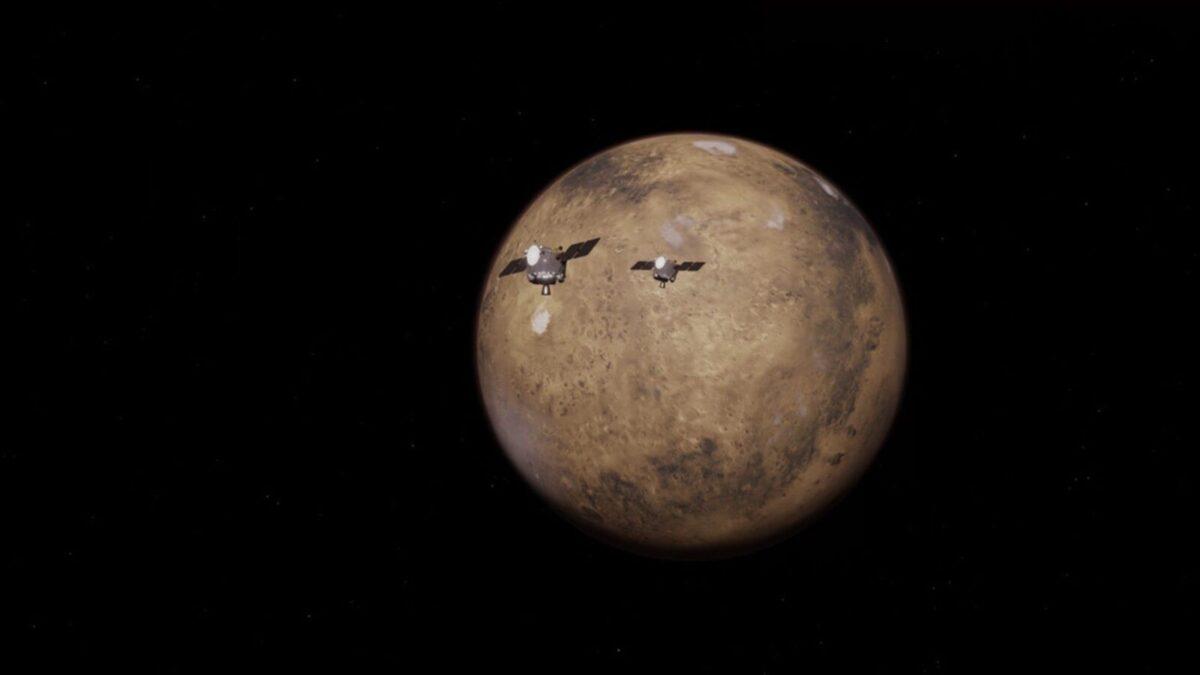
NASA's twin ESCAPADE spacecraft completed powered flybys of Earth on November 7 and November 9, 2026, setting them on course for Mars, according to the agency. The agency says both engine burns went perfectly.
It is a first. "This is the first time NASA has used a powered Earth flyby to propel a spacecraft toward Mars, and we've now executed this maneuver twice, flawlessly, in just two days," said Asal Naseri, acting associate flight director for NASA's Heliophysics Division, in a statement.
Why the probes looped back to Earth
ESCAPADE, short for Escape and Plasma Acceleration and Dynamics Explorers, launched in November 2025. It rode on the second-ever flight of Blue Origin's New Glenn rocket. The probes did not head straight for Mars.
Mars missions normally leave Earth in a brief window that opens only every 26 months, when the two planets line up. ESCAPADE was meant to launch in October 2024, but delays with New Glenn forced it to miss that window.
Rather than wait for this fall, mission planners designed a "loitering" orbit shaped like a kidney bean. The twin probes looped along it and returned to Earth's neighborhood in early November 2026.
"No NASA mission has ever done this before," said Rob Lillis, a planetary and space physicist at the University of California, Berkeley, and principal investigator of the mission. "For most missions, it just isn't necessary."
The burn inside Earth's gravity
Each spacecraft had to fire its engine perfectly while deep inside Earth's gravity well. The maneuver resembles the slingshot flybys spacecraft routinely use to change course. Here, the probes fired their engines to amplify the effect rather than relying on gravity alone.
The first spacecraft performed its burn on November 7. The second followed on Monday, November 9. After a few minor course corrections, ESCAPADE is expected to reach Mars in September 2027.
Science along the way
Each spacecraft is about the size of two refrigerators. Each carries three scientific instruments and a couple of cameras, all tailored to study the strange magnetic field of Mars. That field forms in two ways: globally, as charged particles from the sun interact with the atmosphere, and locally, around areas of highly magnetic crust.
Earth's field is much stronger and generated by the planet's core. The solar wind, the constant stream of charged particles flowing off the sun, still shapes it. On the side facing away from the sun, it stretches the field into an elongated tail, like a windsock.
Earlier missions studied this tail, called the magnetotail, up to nearly 800,000 miles (1.27 million kilometers) from Earth. Beyond that, it was a mystery. The ESCAPADE probes crossed it over about 10 days at roughly 1.19 million miles (1.91 million km) away.
"We were able to capture the magnetic field structure of that distant tail, how it flaps, how it moves, how the plasma flows within it," Lillis said, describing the data as "unprecedented."