Longest Feather Ever Found in Amber Is 105 mm, Study Says
Researchers at East China Normal University describe a 99-million-year-old feather in Burmese amber, the longest three-dimensionally preserved of its kind. Its structure suggests the parts of modern flight feathers evolved step by step, not all at once.
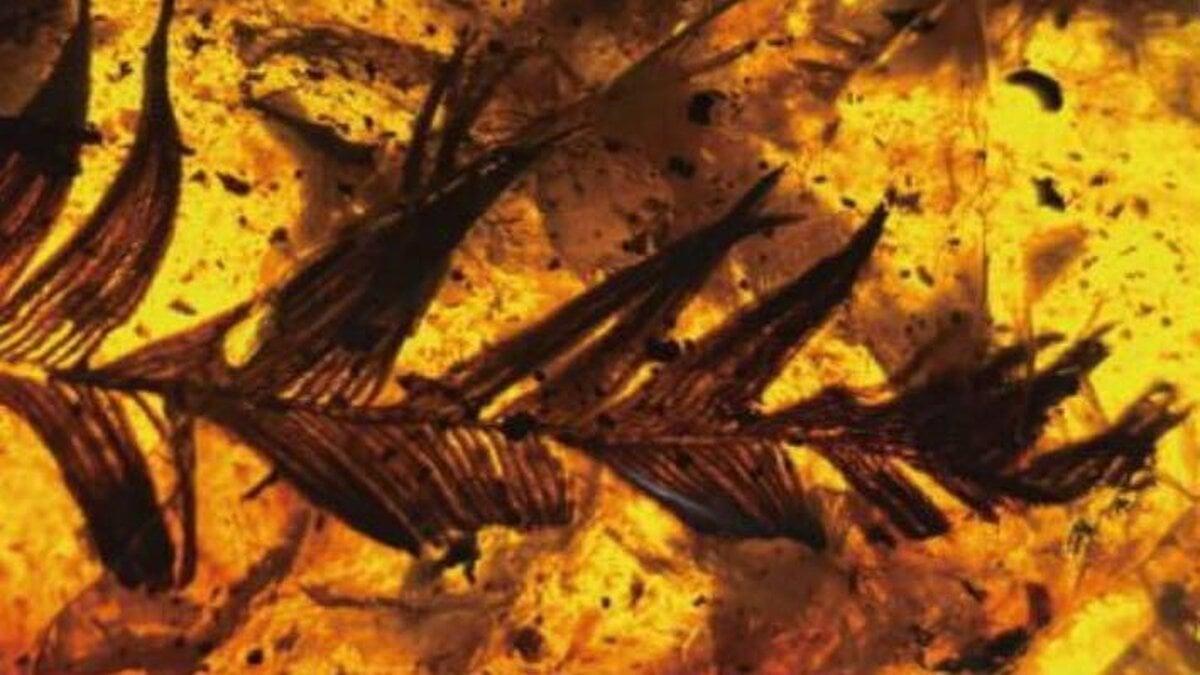
Researchers at East China Normal University have described the longest feather ever found preserved in three dimensions in amber, a 99-million-year-old specimen from Myanmar that spans about 105 mm. The vaned feather dates to the Cenomanian age of the Cretaceous period, according to a study led by Professor Shuo Wang and colleagues.
The find suggests the parts of a modern flight feather did not appear all at once. The team says the structure points to a stepwise evolution.
What the specimen shows
The amber piece is catalogued as ECNU A0033. An anonymous amateur collector donated it in 2016 to the university's Biology Museum.
The preserved portion measures approximately 105 mm, with symmetric vanes up to about 40 mm wide. The scientists estimate the missing base accounts for roughly one-quarter of the original length. They say the complete feather likely exceeded 140 mm.
The feather has two roughly symmetrical vanes made of densely packed branches called barbs. At a glance, it resembles modern flight feathers.
Differences from modern flight feathers
Closer examination showed key differences. The tiny structures linking neighboring barbs, known as barbules, lack hooklets. Without them, the vanes miss the interlocking arrangement that keeps a modern feather's surface continuous.
The central shaft, or rachis, was also incomplete. It was not a fully enclosed, hollow tube. Its underside was open, and it lacked the internal tissue differentiation seen in modern feathers.
Computer simulations suggested this open construction made the feather considerably more flexible under airflow than a model with a solid, cylindrical shaft.
Why amber matters
Most large fossil feathers survive as carbonized compressions, the researchers noted. Fine details such as barbule hooklets and keratin ultrastructure are rarely retained in those. As a result, aerodynamic performance has mostly been inferred from overall shape.
Wang and colleagues said the emergence of vaned feathers is widely seen as a key innovation linked to the dinosaur-to-bird transition, and often treated as a proxy for flight ability. "However, how early feathers gave rise to modern pennaceous feather structures with optimized aerodynamic performance remains unclear," they wrote.
What the authors conclude
The results challenge the assumption that an elaborate, symmetrical feather signals adaptation for flight. The specimen had much of the outer architecture of a modern flight feather. Its internal construction suggests limited aerodynamic capability.
Feather elongation and organized vanes may have come before interlocking barbules and fully differentiated tissues, which improved strength and aerodynamics. The authors wrote that "ECNU A0033 provides direct fossil evidence that pennaceous feather evolution proceeded in a stepwise and modular manner."