BYD Ti7 Boxy SUV Approved for Australia With Two Hybrid Versions
The seven-seat BYD Ti7 has received Australian Design Rule certification, clearing the way for local release. Approval documents list 200kW two-wheel drive and 300kW all-wheel drive plug-in hybrids. The filing puts the SUV at 5146mm long, larger than a Toyota LandCruiser 300 Series.
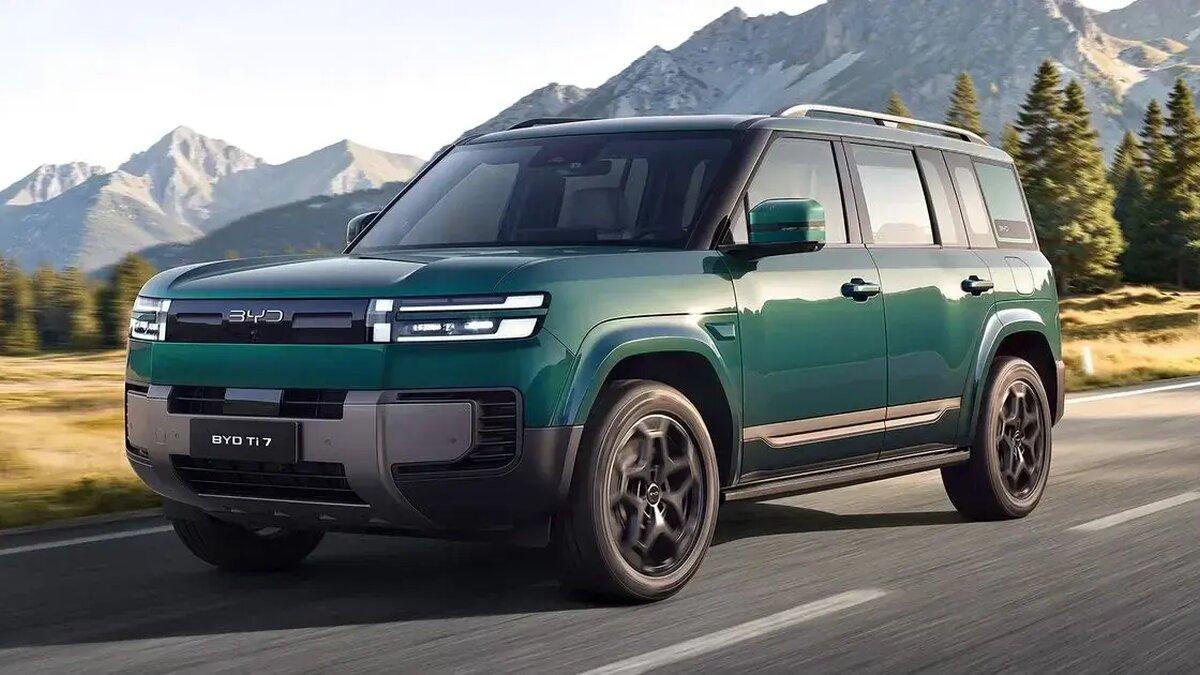
BYD's seven-seat Ti7 boxy SUV has been granted Australian Design Rule certification, giving the vehicle federal government approval for local release. The approval documents were seen on November 9, 2026.
The filing lists two plug-in hybrid (PHEV) versions: a 200kW two-wheel drive model and a 300kW all-wheel drive model. Both use a 1.5-litre turbocharged four-cylinder petrol engine.
Size and seating
BYD's filing gives the Australia-bound Ti7 a length of 5146mm, a width of 1995mm and a height of 1865mm. The wheelbase, the distance between the axles, is 2920mm.
That makes it 147mm longer than the Chinese-market model and larger than a Toyota LandCruiser 300 Series.
Australian buyers will get the Ti7 only as a seven-seater. In China it is sold only with five seats.
Wheels depend on trim level: 255/60 tyres on 19-inch wheels, or 255/55 tyres on 20-inch rims.
Battery details still open
The Australian filing does not state the battery size. BYD UK says the Ti7's engine is mounted longitudinally and mainly works as a generator that recharges the battery pack.
In the UK, the 300kW all-wheel drive model carries a 35.6kWh battery. It is said to have an electric driving range of 119km and a 0-100km/h time of 4.8 seconds.
The Australian two-wheel drive version might use a smaller 26.6kWh unit, as in Chinese-market versions. That is a possibility, not something the filing confirms.
In China, the Ti7 is also sold as a pure-electric vehicle. The rear-wheel drive variant makes 300kW and 365Nm, with a 92kWh or 105.7kWh battery. A more powerful all-wheel drive model uses the larger 105.7kWh pack.
Why it looks different from other BYDs
Unlike the rest of BYD's local range, the Ti7 has an upright, boxy shape that suggests some off-road ability. In China it is sold under the Fangchengbao brand, which also makes sporty sedans and wagons.
Outside China, BYD generally runs two brands. Fangchengbao models are rebranded as either BYDs or Denzas. The Bao 5 and Bao 8 are sold in Australia and Europe as the Denza B5 and B8.
A BYD spokesperson said the Ti7 carries the BYD badge because the B5 and B8 are body-on-frame SUVs, while the Ti7 has a monocoque design. The company aims it at buyers who want rugged styling but do not need go-anywhere capability.
In the UK, BYD is pitching the Ti7 as an "urban box family SUV". The Australian filings confirm nothing about the interior beyond the seating. UK-bound cars have a 15.6-inch central infotainment touchscreen.
BYD has not announced Australian pricing or an on-sale date.