Teghaza 001: 4-Billion-Year-Old Rosetta Stone Found in Sahara
A meteorite discovered in Mali may preserve evidence of how water altered Mars’ early crust. Researchers dated the rock using zircon crystals and a rubidium-strontium technique, identifying it as one of the three oldest Martian meteorites ever found and pointing to 13 possible places where it formed.
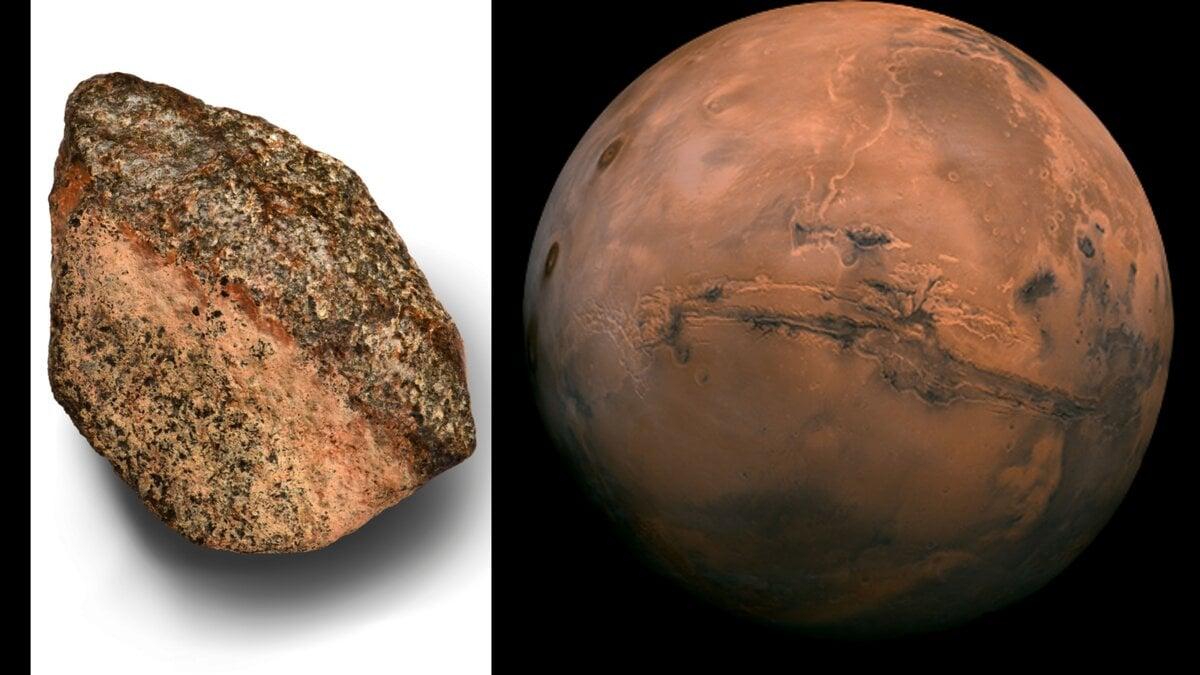
Teghaza 001, a Martian meteorite discovered in Mali in 2022, offers evidence that water altered Mars’ crust around 4.1 billion years ago, researchers said. The 4-billion-year-old rosetta stone found in the Sahara may help scientists investigate the planet’s early water history.
The rose-colored rock weighs roughly 1.8 pounds (800 grams) and formed more than 4.1 billion years ago. It is one of the three oldest Martian meteorites ever found.
An impact blasted the meteorite off Mars before it eventually landed on Earth. Its name comes from the salt plain in Mali where it was found.
Teghaza 001 contains a distinctive combination of igneous minerals and textures. Its composition resembles material observed in Mars’ southern highlands by NASA’s Mars Reconnaissance Orbiter, while its unusual features preserve clues to the rock’s complex history.
Researchers cannot pinpoint where on Mars it originated, but they identified 13 possible locations where it may have formed.
“One of the paper’s reviewers called it a Rosetta Stone for Mars,” research leader Yang Liu of NASA’s Jet Propulsion Laboratory in Southern California said. Liu said the team recognized the meteorite’s uniqueness only after examining it closely.
Scientists first identified the rock as Martian through its oxygen isotopes. They then examined tiny zircon crystals embedded in it and used a specialized rubidium-strontium dating technique to analyze individual mineral grains on the surface.
The method allowed researchers to assess the meteorite while preserving it for future analysis. The study marks the first time scientists have used rubidium-strontium dating to analyze an ancient Martian meteorite.
The results indicate that water altered Teghaza 001 around 4.1 billion years ago, meaning the rock itself formed earlier. Mineral and chemical evidence points to water interacting with ancient Mars’ crust and may preserve an imprint of the atmosphere as the planet lost water.
“It records interactions of water and rock and maybe even an imprint of the Martian atmosphere as it was losing water,” team member Lee Saper of NASA’s Ames Research Center in Silicon Valley said.
The findings were published Thursday, October 29, in the journal Science. A separate study of the meteorite’s water content appeared June 10 in Science Advances.
Researchers said further analysis could reveal more about how water shaped Mars’ surface and influenced the planet’s evolution. “We’ve only scratched the surface,” Liu said.